English
English is a core subject with the ability to read and write affecting the whole of the curriculum.
English can be broken down into the following Key areas:
Reading
Reading is a vital skill for life and our aim is for our children to be confident readers who enjoy reading for life. At SWINS we aim to achieve his by:
- promoting the enjoyment of books by teachers reading to children
- having a warm, positive teacher/pupil relationship which encourages discussion with each other
- experiencing pleasure in handling and looking at books and other printed materials
- providing a wide variety of books to choose from- within the class library, the school library, the county book bus and county libraries
- encouraging children to take home reading for pleasure books and to share this pleasure with their parents
- promoting paired reading with parents at home with both printed and e-books
In the early years we will encourage and support children in the development of pre-reading skills as part of the process to becoming fluent readers.
As Key Stage 1 children will be part of a group of similar ability for reading. Teachers will hear children read as part of a shared read session and children will take books home regularly to share and support their reading development.
Super Six
Stories, Poetry and Nonfiction are read to children at all stages within the school to stimulate their reading for pleasure. To ensure a range of books throughout school we have six books dedicated to each half term that will be part of what is read aloud to children. Below you can see the SUPER SIX for each year group.
The school has a well-stocked library with a wide range of books. Reading for pleasure books are sent home alongside phonically matched books to support each child’s learning.
See the dedicated reading page by clicking here.
Reading Page
Speaking and Listening
The development of speaking and listening skills are an important part in developing children’s literacy skills. The ability to articulate information, ideas and opinions is an important life skill. In addition, we believe that if you can’t say it you can’t write it so at SWINS children are given plenty of opportunities to talk and listen in a number of different ways including:
- exploring, developing and explaining ideas
- sharing ideas and opinions
- reading aloud, telling and enacting stories and poems
- presenting to audiences, live or recorded
- planning predicting and investigating
- reporting and describing events
Vocabulary is an important focus of Speaking and Listening and specific vocabulary progressions have been developed for all foundation subjects. These can be found on each subject page.
Writing
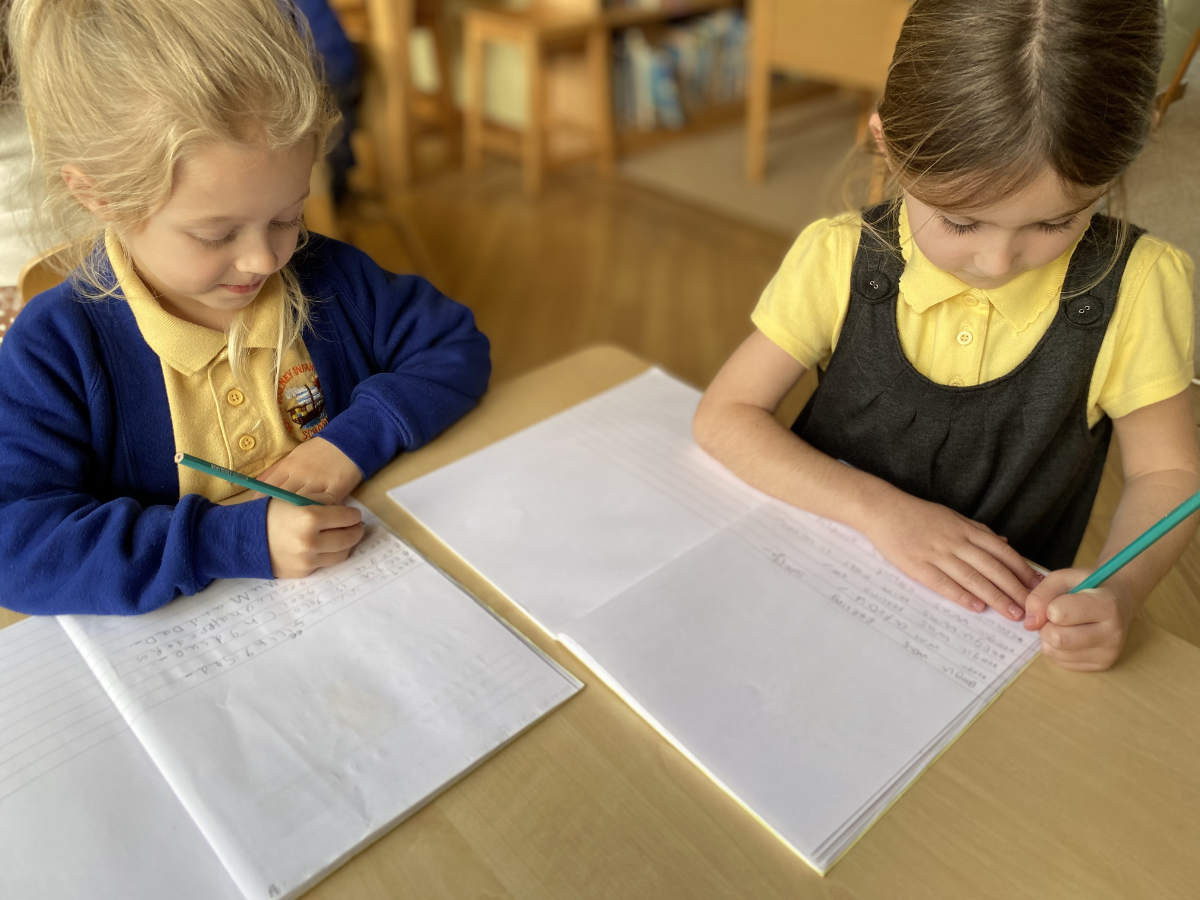
Children are encouraged to see themselves as writers from the moment they start in Reception. They are encouraged to communicate through writing in play situations and then as they become more confident and develop their letter sound association knowledge to use writing in a more structured way. Opportunities are given to children to produce writing which ahs been directed by the teacher as well as independent writing.
In Key Stage 1, the teaching of spelling and handwriting is combined with phonics (sounds). Knowledge of letter sounds help children to spell correctly an to tackle unknown words when reading. A specific programme, ‘Success for All’ is used.
In Key Stage 1, children continue to be taught correct letter formation and also the simple rudiments of grammar for example, capital letters and full stops, exclamation marks, question marks etc. In Years 1 and 2 children are taught how to develop vocabulary skills in the whole class situation and in small groups. They are also encouraged to write independently to communicate their thoughts in all areas of the curriculum.
Raising standards in writing continues to be a priority for he school. the school uses Ros Wilson’s Big Writing strategies to encourage children to enjoy writing and to improve their writing skills, especially in their use of vocabulary, grammar and punctuation.
During their time at SWINS children will have be taught the following:
- how to develop ideas for writing
- simple rules of grammar and vocabulary
- how to check their work
- increased neatness and accuracy in writing
- spelling programmes that build knowledge and awareness of the rules of spelling
Drama
Drama contributes to language and to he general education of children because:
- Drama is a form of communication
- Drama is a means of self-expression
- Drama helps develop the imagination
- Drama helps to promote growth in the ability to use language
- It helps develop sensitivity
- It reinforces concentration and listening skills and allows children to enjoy participating in a group activity
- Drama is fun to do. It fosters a sense of self achievement without having to use a pencil and paper.
For all of the above reasons we encourage Drama work at SWINS.
English
Policy
Programme of Study
What does Writing look like in Early Years?
SEND Inclusion Statement - Phonics
SEND Inclusion Statement - Reading